New Update Chrome v122 new 'IP Protection' will hide users' IP addresses

CyberTech

Level 44
Thread author
Verified
Top Poster
Well-known
Forum Veteran
Nov 10, 2017
3,135
1
22,994
4,269
Google is getting ready to test a new "IP Protection" feature for the Chrome browser that enhances users' privacy by masking their IP addresses using proxy servers.

Recognizing the potential misuse of IP addresses for covert tracking, Google seeks to strike a balance between ensuring users' privacy and the essential functionalities of the web.

IP addresses allow websites and online services to track activities across websites, thereby facilitating the creation of persistent user profiles. This poses significant privacy concerns as, unlike third-party cookies, users currently lack a direct way to evade such covert tracking.

Initially, IP Protection will be an opt-in feature, ensuring users have control over their privacy and letting Google monitor behavior trends.

The feature's introduction will be in stages to accommodate regional considerations and ensure a learning curve.

Full article:

Post has been mod edited.
 
Last edited by a moderator:

Potential security concerns

Google explains there are some cybersecurity concerns related to the new IP Protection feature.
As the traffic will be proxied through Google's servers, it may make it difficult for security and fraud protection services to block DDoS attacks or detect invalid traffic.
Furthermore, if one of Google's proxy servers is compromised, the threat actor can see and manipulate the traffic going through it.
To mitigate this, Google is considering requiring users of the feature to authenticate with the proxy, preventing proxies from linking web requests to particular accounts, and introducing rate-limiting to prevent DDoS attacks.
Traffic will be proxied through Google's servers... :(
So, no thanks.
 
I love how everyone acts like Google is the only entity to do this.

Everywhere you go and everything you do is fingerprinted, cookies set, twitter, Amazon, Facebook "list gets long" tracks everything you do, and they are not offering you services as you do, you do not even require an account with those services to be tracked.

It gets silly seeing this same argument, at least Google is straight about it, you know they are about advertisment.
 
I love how everyone acts like Google is the only entity to do this.

Everywhere you go and everything you do is fingerprinted, cookies set, twitter, Amazon, Facebook "list gets long" tracks everything you do, and they are not offering you services as you do, you do not even require an account with those services to be tracked.

It gets silly seeing this same argument, at least Google is straight about it, you know they are about advertisment.
True but some (big) data baskets collect more eggs than others, so the perception on Google is not silly
(all your data belongs to us, you will be assimilated, resistance is futile and privacy an illusion)
1698179888899.png
 
True but some (big) data baskets collect more eggs than others, so the perception on Google is not silly
(all your data belongs to us, you will be assimilated, resistance is futile and privacy an illusion)
View attachment 279355

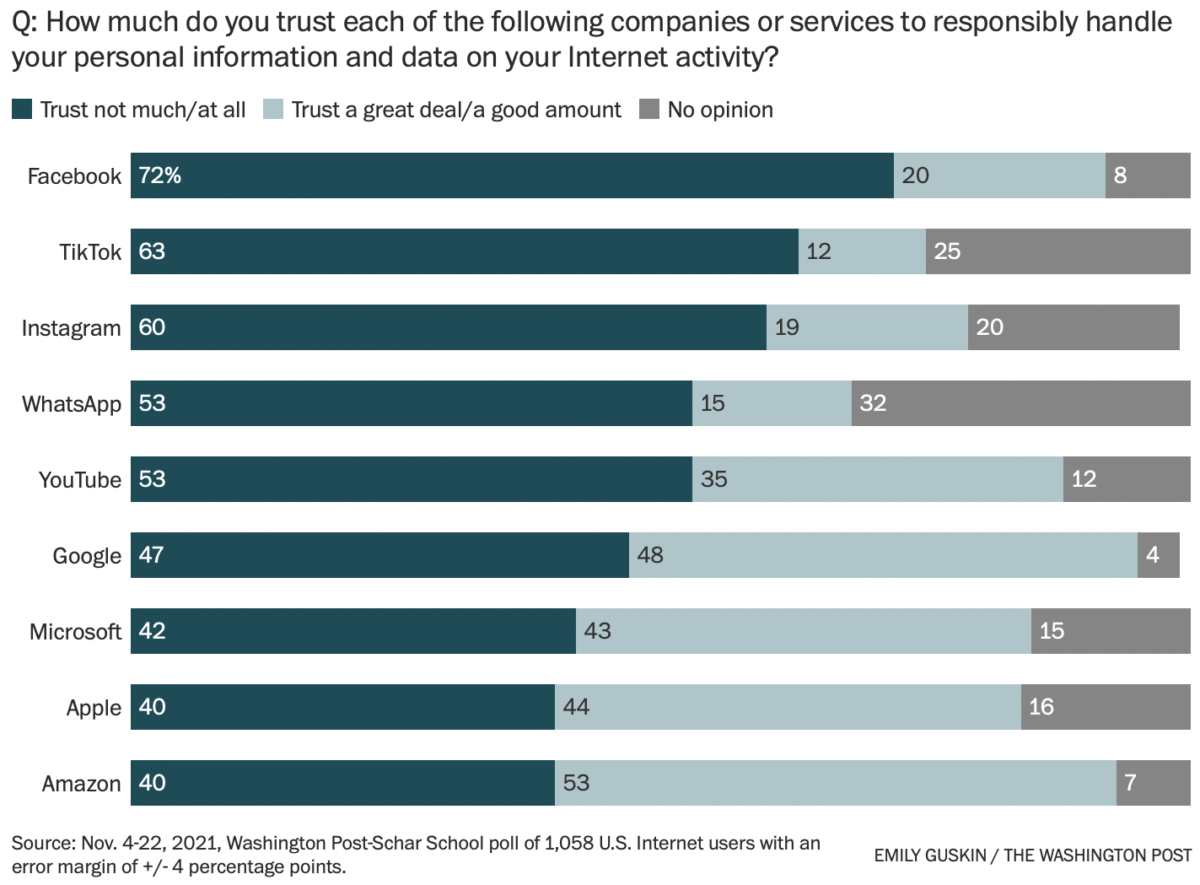
Trust is a funny thing. So your graph above, no details of when it was performed and by who.

Notice the time line on mine 🤔🙃😁

Only Google gets the great mentions. It is silly, just like your attempts to poke.

WP-Apple-data-survey-1200x885.png
 
Last edited by a moderator:
True but some (big) data baskets collect more eggs than others, so the perception on Google is not silly
(all your data belongs to us, you will be assimilated, resistance is futile and privacy an illusion)
Yes. And these shown in your picture can easily be blocked with e.g. uBlock Origin. :)
This new Google "feature" (which affects all the sites you visit!) can only be turned off, which most users won't do.
 
Google's plan to prevent marketers from tracking Chrome users across different websites by anonymizing IP addresses is being challenged by, surprise surprise, a marketing advocacy group.

The Movement for an Open Web (MOW), an organization that has lobbied against Google's Privacy Sandbox initiative by claiming it's harmful to rival internet advertising businesses, has filed a complaint with the UK's Competition and Markets Authority (CMA) over Google's IP Protection proposal.

IP Protection is expected to appear in a future version of Chrome, possibly as soon as January 2024 with the debut of Chrome 122.
Read more: Google Chrome IP address protection challenged by industry
 
It's designed to run Chrome browser connections through two proxies, one operated by Google and one operated by a third-party ... The Google-run proxy can observe the user's IP address but not the websites being visited and the third-party proxy can see the web servers being visited but not the IP address of the visitor.
 

You may also like...